Friday, May 20, 2016

Architectural Details of the Provo City Temple -


This is so remarkable and beautiful - enjoy!  

Why Go To Church?

If you're spiritually alive, you're going to love this! 
If you're spiritually dead, you won't want to read it.
If you're spiritually curious, there is still hope!


A Church-goer wrote a letter to the editor of a newspaper and complained that it made no sense to go to church every Sunday:

'I've gone for 30 years now,' he wrote, 'and in that time I have heard something like 3,000 sermons, but for the life of me, I can't remember a single one of them. So, I think I'm wasting my time and the preachers and priests are wasting theirs by giving sermons at all.'

This started a real controversy in the 'Letters to the Editor' column.  Much to the delight of the editor, it went on for weeks until someone wrote this clincher:

'I've been married for 30 years now. In that time my wife has cooked some 32,000 meals. But for the life of me, I cannot recall the entire menu for a single one of those meals. But I do know this: They all nourished me and gave me the strength I needed to do my work. If my wife had not given me these meals, I would be physically dead today. Likewise, if I had not gone to church for nourishment, I would be spiritually dead today!

When you are DOWN to nothing, God is UP to something!  

Faith sees the invisible, believes the incredible and receives the impossible!  Be Thankful to God for our physical & our spiritual nourishment!  

IF YOU CANNOT SEE GOD IN ALL, YOU CANNOT SEE GOD AT ALL !

B. I. B. L. E. simply means: Basic Instructions Before Leaving Earth!

When you are about to forward this to others, the devil will discourage you.    So go on! Forward this to people who are DEAR to you and TRUST GOD.

The Fiery Sernon


A member of the church had gone inactive. After a few weeks, Bishop decided to visit him - it was a chilly evening. Bishop found the man at home alone, sitting before a blazing fire. Guessing the reason for his shepherd's visit, the man welcomed him, led him to a comfortable chair near the fireplace and waited. 


Bishop made himself at home but said nothing. In the grave silence, he contemplated the dance of the flames around the burning logs. After some minutes, Bishop took the fire tongs, carefully picked up a brightly burning ember and placed it to one side of the hearth all alone then he sat back in his chair, still silent. 


The host watched all this in quiet contemplation. As the one lone ember's flame flickered and diminished, there was a momentary glow and then its fire was no more. Soon it was cold and dead. Not a word had been spoken since the initial greeting.


Bishop glanced at his watch and realized it was time to leave. He slowly stood up, picked up the cold, dead ember and placed it back in the middle of the fire. Immediately it began to glow, once more with the light and warmth of the burning coals around it. As he reached the door to leave, his host said with a tear running down his cheek, 'Thank you so much for your visit and especially for the fiery sermon. I will be back in church next Sunday.' 


We live in a world today, which tries to say too much with too little. Consequently, few listen. Sometimes the best sermons are the ones left unspoken.

Apostles Testimony Montage From First Talk

In General Conference!!!!


The Right Side of Me!!


Thursday, May 19, 2016

Maxine's At It Again - Fun With Words!


Why isn't the number 11 pronounced onety-one?

If  4 out of 5 people SUFFER from diarrhea...
does
 that mean that one out of five enjoys  it?

Why do croutons come in airtight packages?  
Aren't they just stale bread to begin with?                        

If people from Poland are called Poles,
then why aren't people from Holland called Holes?


If a pig loses its voice, is it disgruntled?                   
 Why is a person who plays the piano called a pianist,
but a person who drives a race car is not called a racist?
         
If it's true that we are here to help others,
then what exactly are the others here for?
  
If lawyers are disbarred and clergymen defrocked,
then doesn't it follow that electricians can be delighted,
musicians denoted, cowboys deranged,  models deposed,
tree surgeons debarked, and dry cleaners depressed?
  
    
Do Lipton Tea employees take 'coffee breaks?'

What hair color do they put on the driver's licenses of bald men?                         
I  thought about how mothers feed their babies
with tiny  little spoons and forks,
so I wondered what do Chinese mothers use, toothpicks?


Why do they put pictures of criminals up in the Post  Office?
What are we supposed to do, write to them?
Why don't  they just put their pictures on the postage stamps
so the mailmen can look for them while they deliver the mail?
                          
Is it true that you never really learn to swear until you learn to drive?                          
If a cow laughed, would milk come out of her nose?

Whatever happened to Preparations A  through G?
******
 
Why do we press harder on the remote control
when we know the batteries are getting weak?

Why do banks charge a fee due to insufficient funds when
they already know you're broke?

Why is it that when someone tells you that there are one billion stars in the universe you believe them, but if they tell you there is wet paint you have to touch it to check?

Why doesn't Tarzan have a beard?

Why does Superman stop bullets with his chest,
but ducks when you throw a revolver at him?

Why did Kamikaze pilots wear helmets?

Whose cruel idea was it to put an "s" in the word "lisp"?

If people evolved from apes, why are there still apes?

Why is it that, no matter what color bubble bath you use,
the bubbles are always clear?

Is there ever a day that mattresses are not on sale?

Why do people constantly return to the refrigerator with hopes
that something new to eat will have materialized?

Why do people run over a string a dozen times with their vacuum cleaner,
 then reach down, pick it up, examine it
and then put it down to give the vacuum one more chance?

How do those dead bugs get into the enclosed light fixtures?

Why is it that whenever you attempt to catch something
that's falling off the table you always
manage to knock something else over?

Why, in winter, do we try to keep the house as warm as
it was in summer when we complained about the heat?

Do you ever wonder why you gave me your e-mail address in the first place?

And A FAVORITE:

The statistics on sanity say that one out of every four
persons is suffering from some sort  of mental illness.
Think of your three  best friends.
  If they're  OK..? (then it's you!)  
~  
REMEMBER, A day without a smile is like a day without sunshine!                     
 And a day without sunshine is, like...........night!!!!


Answers to Four Questions about Prayer

https://www.lds.org/prophets-and-apostles/unto-all-the-world/answers-to-four-questions-about-prayer?lang=eng&cid=email_inspiration-and-news_6-2015_header1

Elder D. Todd Christofferson of the Quorum of the Twelve Apostles answers four questions about prayer:
  1. How can I make daily prayer more meaningful?
  2. How do you have the Spirit with you when you pray?
  3. How often should we pray?
  4. What if we don’t get an answer to our prayers when we want it or need it?

1. How can I make daily prayer more meaningful?

How can I make daily prayer more meaningful? It’s a good question, and it’s one that applies to all of us. President Hinckley used to say that sometimes when we pray it’s like we’re picking up a phone, ordering groceries, and then we hang up the phone—we put in our order, and we don’t think any more about it than that. But if we take a few minutes just to think about our particular need in a given moment, then prayer becomes more meaningful.
In 2 Nephi 32:9 it says, “Behold, I say unto you that ye must pray always, and not faint; that ye must not perform any thing unto the Lord save in the first place ye shall pray unto the Father in the name of Christ, that he will consecrate thy performance unto thee, that thy performance may be for the welfare of thy soul.”

Everything we do ought to be done with an eye toward our Heavenly Father’s blessing and consecrating to our good all of our activities in a given day. So if we sense our need and think about it, prayer becomes more meaningful.
Beyond that, it’s important to remember we shouldn’t just be praying about ourselves, because there are a lot of people in our sphere of acquaintance who have great needs as well, and we ought to be remembering them and what kind of help they need from the Lord. Those kinds of prayers are like when Enos prayed. He prayed about himself first and then about the Nephites and then the Lamanites—even his enemies were a part of his concern. That really makes prayer meaningful, to focus on others.
Lastly, when you’re grateful, when your prayers include a lot of thanks to the Lord for your blessings, they become much more meaningful.

2. How do you have the Spirit with you when you pray?

This is crucial. It makes all the difference. Remember the promise we find in Moroni 10:4. It tells us to pray about the Book of Mormon “with a sincere heart, with real intent.” And when we say “sincere heart” and “real intent,” it means that you want to know the Lord’s will and you want to do it, that you’re committed, as you pray, to knowing and doing His will. And that makes prayer very meaningful. If we’re just praying for what wewant and we don’t want to know His will, it won’t be the same feeling or have the same meaning.
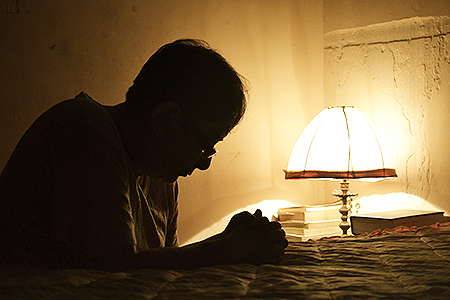
Years ago when I was serving as a bishop and was weighed down with all of the problems members of the ward seemed to have, I began praying about finding solutions and ways to help. I got some impressions in answer to my pleas for help. Then, it seemed that the Spirit would guide my prayer so that what I was praying was guided by the Spirit as well as what came back in answer to my prayers. And I think that’s the most meaningful kind of prayer we can achieve, where the Spirit guides the prayer as well as the responses from our Heavenly Father. And I believe that comes when we really do want to know what the Lord wants and we’re committed to do whatever that is as we pray.

3. How often should we pray?

There really is not a rule. We don’t have a set number. I think as you go through a day, it’s natural to pray about things as they come along.
Elder David A. Bednar talked in a general conference about prayer and praying always (see “Pray Always,”Ensign, Nov. 2008, 41). He said if our morning prayers are looking out toward the day and what’s coming, we’re previewing the day in our prayer. In our evening prayers, we report to the Lord on what’s happened through the course of the day. We may be thanking Him for blessings received, we may be repenting of a few things that happened that were not right, and then there are all the prayers in between. It just becomes part of a stream of prayers. It’s all part of a pattern, and that goes on day in and day out and week after week and through the years. That’s what it means to have your heart drawn out in prayer to Him.
One other scripture comes to mind, from Alma 37:36–37:
“Cry unto God for all thy support; yea, let all thy doings be unto the Lord, and whithersoever thou goest let it be in the Lord; yea, let all thy thoughts be directed unto the Lord; yea, let the affections of thy heart be placed upon the Lord forever.
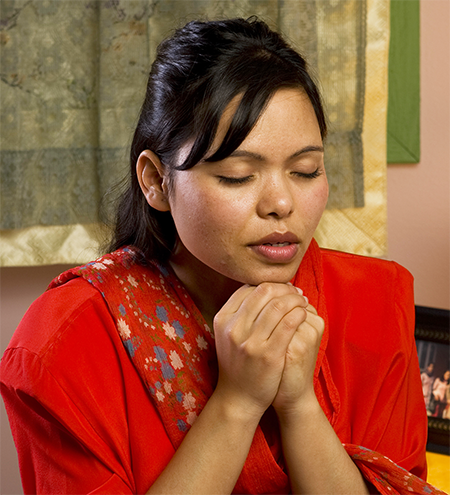
“Counsel with the Lord in all thy doings, and he will direct thee for good; yea, when thou liest down at night lie down unto the Lord, that he may watch over you in your sleep; and when thou risest in the morning let thy heart be full of thanks unto God; and if ye do these things, ye shall be lifted up at the last day.”
Sometimes it’s a very, very simple prayer in a stressful crisis. (“Help. Please help me.”) So we’re talking about our thoughts going to Heavenly Father. Our prayers can be brief through the course of the day, and it’s just what flows out of us naturally. The closer we get to Him, the more that happens automatically and we feel that closeness. It’s like having a friend and walking together through a hallway at school. You want to turn and talk to each other about what’s going on at the moment. And as you draw closer to God, that companionship, that friendship, if you will, tends to develop in the same way.
That being said, don’t forget that we ought to look for opportunities when we can have long prayers, when we can have a quiet time and will not be interrupted. We need a time where we can pray as long as we feel we want to and need to, where Heavenly Father can teach us and talk to us at length and not just always be responding to a quick prayer—that’s fine for the moment but not all we should ever do.

4. What if we don’t get an answer to our prayers when we want it or need it?

That’s an interesting question. It brings to mind something that Elder Richard G. Scott said in a general conference talk: “What do you do when you have prepared carefully, have prayed fervently, waited a reasonable time for a response, and still do not feel an answer? You may want to express thanks when that occurs, for it is an evidence of His trust. When you are living worthily and your choice is consistent with the Savior’s teachings and you need to act, proceed with trust. As you are sensitive to the promptings of the Spirit, one of two things will certainly occur at the appropriate time: either the stupor of thought will come, indicating an improper choice, or the peace or the burning in the bosom will be felt, confirming that your choice was correct. When you are living righteously and are acting with trust, God will not let you proceed too far without a warning impression if you have made the wrong decision” (“Using the Supernal Gift of Prayer,” Ensign, May 2007, 10).
It’s a valuable experience sometimes to pray and not immediately receive the answer you feel you need. It’s all conditioned, of course, on our living the way we should, continuing to seek His guidance, and being open to those promptings.
We ought to remember we don’t dictate to God the timing of His answers to us and the content of what comes in response to our prayers. I learned this when I was about 16. I was in the pageant at Hill Cumorah. I lived in New Jersey at the time, and they had some of the youth from New Jersey and New York as participants. I thought I had a deep belief in the Prophet Joseph Smith and the Book of Mormon and felt that they were true and that the First Vision was as he described it. I thought, “This is the perfect chance. I’ll go to the Sacred Grove one night after the performance and get the final confirmation I need there.”

So I did. I went there late one night. It was a beautiful summer evening. Nobody else was there—perfectly reverent and peaceful. And I prayed. I didn’t ask for anything specific. I just said, “Can I have some confirmation of my belief?” Really I wanted a testimony of my feeling about the Prophet and the Book of Mormon.
Nothing happened. I prayed a long time—I’m sure more than an hour. Nothing. I was really disappointed. I said, “What did I do wrong? Why didn’t the Lord answer me? Wasn’t it the perfect place, the perfect time? What should I have done that I didn’t do?”
Later, what I was looking for came, but it was at home in a quiet moment when I was reading the Book of Mormon. That witness from the Holy Ghost flooded over me, and I knew. I knew I knew. And when I looked back on the experience, I said, “Why didn’t He answer my prayer then? Why was it later?” I learned two important lessons from that:
First, you don’t have to be any place special for the Lord to answer your prayer. You don’t have to make a pilgrimage to Palmyra or Jerusalem or anything like that. He knows where you are. He knows your name. He can answer you right here, right now, any moment.
And second, you don’t dictate to God. You just don’t tell Him what and when. That comes according to His will and His timing and His wisdom. He loves us; He knows what’s best for us, and our job is to be open. Our job is always to be willing and ready to receive. Then He knows what’s best and when to answer us and how to answer us. So, after all is said and done, we still have to live by faith.
Prayer is one of the things that will give us the strength and the power to be examples of the believers. The influence of the Lord, the meaningfulness of our prayers, His guidance  in our life day to day, the strength that comes with all of that really does make it possible for us to consistently be examples of the believers in everything we do.

Friday, January 15, 2016

Dad, I'm Thinking Of Something . . .


One rainy afternoon I was driving along 
one of the main streets of town,
taking those extra precautions necessary 
when the roads are wet and slick.
Suddenly, my daughter, Aspen, spoke up from 
her relaxed position in her seat.
"Dad, I'm thinking of something."

This announcement usually meant she had been 
pondering some fact for a while,
and was now ready to expound all that her 
six-year-old mind had discovered.
I was eager to hear. "What are you thinking?" I asked.

"The rain," she began, "is like sin,
and the windshield wipers are like God wiping our sins away."
After the chill bumps raced up my arms I was able to respond.
"That's really good, Aspen."

Then my curiosity broke in.
How far would this little girl take this revelation?
So I asked..
"Do you notice how the rain keeps on coming?
What does that tell you?"

Aspen didn't hesitate one moment with her answer:
"We keep on sinning, and God just keeps on forgiving us."

I will always remember this whenever I turn my wipers on.
Funny how I can be more worried about what other
people think of me than what God thinks of me.
In order to see the rainbow,
you must first endure some rain!
 

For I know the thoughts that I think toward you, 
saith the Lord, thoughts of peace, and not of evil, 
to give you an expected end.
Jeremiah 29:11

Wednesday, January 13, 2016

Incredible LDS Conversion of a Librarian at the Vatican

Imagine working as a librarian at the Vatican and coming across an ancient text talking about eternal marriage, written by some of Jesus’ Disciples. Here’s the incredible LDS conversion story of a Vatican Librarian.                                 Enjoy the video!

Friday, October 16, 2015

The Gospel According to Scoot

Read below, or click on the link to take you to the original web page

http://scottstover.wordpress.com/2013/03/29/402/


The Gospel According to Scoot
Zion vs. Babylon – Two Ways Only
Posted by scootd28 on March 29, 2013

I have been quite occupied lately with thoughts of Zion.  I wrote recently of the impressions I received after my study of D&C 78.  My wife and I read together John Pontius’ account of “Spencer’s” visions of Zion in the book “Visions of Glory”.  Most importantly, though, I was prompted to re-read Hugh Nibley’s “Approaching Zion”, a collection of essays in which he boldly calls the church and its members to task for rejecting the United Order and the Law of Consecration. 


One should understand that this is a 600+ page book written by one who is considered by many to be one of the greatest LDS scholars who ever lived.  While this book demonstrates that he is not only a world-class scholar, but also a spiritual giant, it is not something most sane people would subject themselves to once, let alone twice, yet I have been devouring it again with a sure knowledge that it contains a message that is quite pertinent to my salvation.

One night not too long ago, while lying in bed having read D&C 42 that morning and having read some from Professor Nibley that evening, I was casually praying as I often do while falling asleep.  I kept repeating to the Lord, “You commanded us, and we rejected it!  You commanded us, and we rejected it!”  I just can’t get over that thought!  I feel so saddened and helpless, and I don’t know what to do about it!  The early church rejected it, but I don’t have to, right?  Yet, how can I begin to truly live the law of consecration the way the Lord commanded?  There is no system set up for me to just give all my “surplus” to the church; the bishop would probably laugh at me, or tell me that he simply has no place to store it.  I continue to be haunted by that thought…You commanded us, and we rejected it!  I just do not want to be part of a people or a church who outright rejected the Lord’s commandment.

I feel compelled to make it clear that my purpose in writing this is not to criticize anyone.  I do not know how I would have reacted in those circumstances.  I am not criticizing the saints, the church, or its leaders, either then or now.  So when I say, “I do not want to be part…..”, I am simply expressing my honest thoughts and feelings, not declaring an open rebellion.  I am declaring, though, that I don’t want to perpetuate this less-than-optimal situation by exclaiming “All is well in Zion” and going merrily along my way. I am declaring my intent to search diligently for an understanding of what the Lord would have me do under the circumstances that exist today.

As one might expect, I began praying, and I actually received a measure of comfort.  I felt the Lord saying, “Don’t worry about it…..you don’t have a problem”.  I can accept this – my wife and I live in a very modest home, we drive old cars, we are fairly generous in helping our family, and there is nothing about us that would give any indication that we have our hearts set on riches.  We served a full-time mission while we were in our mid-50’s and far from retired or financially “secure”.  Yet, I remain decidedly uncomforted.  Instead, I want to shout to the world, “Don’t you see!  All of our problems – the economy, the temptation and burden of debt, the wars, the environment, the blatant attacks on liberty – it’s all because we are living by Satan’s system – a system that was initiated through Cain and which is perpetuated with increasing boldness by the secret combinations of our day.” It is a system into which are sown the seeds of “death, decay, dirt, diabolism and despair” (Frederick Warburg, “Publisher’s Report,”, All Authors Are Equal, as quoted in “Approaching Zion” by Hugh Nibley).

Our current economic system, even capitalism, carries in it the seeds of self-destruction!  Unless tempered by charity – true charity, the pure love of Christ – capitalism necessarily leads to exploitation of the poor by the rich.  The “distribution of wealth” unavoidably begins to assume the model we see today, with roughly 90% of the wealth in the United States being held by 10% of the people.  I recently came across this study showing that 40% of the wealth in the US is held by 1% of the population.  Pareto’s law, the famous 80/20 rule, dictates that, statistically, unless acted upon by outside forces, 80% of the wealth in any system will naturally gravitate into the hands of 20% of the people.  Yet, the scriptures repeatedly tell us that in Zion there shall be no poor – that there should not be any who are above another.  D&C 78:5-6 says:

“That you may be equal in the bonds of heavenly things, yea, and earthly things also, for the obtaining of heavenly things. For if ye are not equal in earthly things ye cannot be equal in obtaining heavenly things;

The contrast between the Lord’s way and Satan’s way is stunning, to say the least.

Money is popularly described as “the root of all evil”, but this is actually derived from Paul’s statement that “the love of money is the root of all evil” (1 Timothy 6:10).  I’m starting to realize the extent to which both statements are true – even that money itself is evil.  Satan himself revealed his hand when he said, “You can buy anything in this world with money”.  Why is money such a problem?  I think I have figured it out.  In the current movie, “Oz, the Great and Powerful”, there is a scene which depicts what has become cliché over the centuries – that of a poor man coming across a treasure of unimaginable magnitude.  In this case, Oz is introduced into a cavern full of gold which is promised him if he is indeed the great and powerful wizard of prophecy.  This humble, if not entirely honest man became, of course, immediately ecstatic over it – literally swimming in the piles of treasure; but why? (He is ultimately redeemed, for anyone who is concerned).  One cannot eat gold.  Gold doesn’t help one gain love or true respect.  Gold cannot clothe or shelter you.  Gold certainly does not in any way make one more comfortable.  In a world without money, only possessions that are useful have value, and they only have value if they are being used.  All the gold in the world doesn’t do one any good if one is cold and hungry and alone.  Likewise all the money in the world does no good except as it allows one to acquire those needed things.  A person can hoard possessions all they want, but it does them no good.  One only receives value from possessions that bring them comfort and enjoyment.  But if a person hoards money…especially if it is in limited supply (or a controlled supply – think Federal Reserve), that person can bribe others to do his or her bidding because he has the money and they don’t, and they need the money to acquire the goods that bring them comfort and enjoyment.  The person who has the money thus has power over others.  Money makes it easier to acquire power and gain.  Oh the cunning of that evil one!  It is so obvious to me now, yet we all buy into it.  One might say we are, in our world today, trapped by it.

So, if capitalism is not the answer, then what is?  Some foolishly suggest that socialism, or some form of socialism, is necessary to achieve Zion, but this is simply forced distribution of wealth – a blatant attack on agency.  You see, Satan has us coming and going.  Both systems are designed to give the few power over the agency of the many.  With capitalism, he has the few setting their hearts on riches and getting them, thereby turning away from God, and everyone else being covetous of the rich.  Socialism is simply a variation on the same theme.   The result, from a spiritual standpoint, is the same.  Either way, agency is compromised.  Note 3 Nephi 6:15:

14 And thus there became a great inequality in all the land, insomuch that the church began to be broken up; yea, insomuch that in the thirtieth year the church was broken up in all the land save it were among a few of the Lamanites who were converted unto the true faith; and they would not depart from it, for they were firm, and steadfast, and immovable, willing with all diligence to keep the commandments of the Lord.

15 Now the cause of this iniquity of the people was this-Satan had great power, unto the stirring up of the people to do all manner of iniquity, and to the puffing them up with pride, tempting them to seek for power, and authority, and riches, and the vain things of the world.

 16 And thus Satan did lead away the hearts of the people to do all manner of iniquity; therefore they had enjoyed peace but a few years.

 I am convinced now that the answer is explained in “Work We Must, but the Lunch is Free”, Professor Nibley’s talk given in 1982 before the Cannon-Hinkley Club.  In it, he reminds us that everything we have is a gift from God.  We own nothing – we are merely stewards.  In other words, there is a free lunch.  The Lord tells us in D&C 104:17-18:

…for the earth is full, and there is enough and to spare; yea, I prepared all things, and have given unto the children of men to be agents unto themselves.  Therefore, if any man shall take of the abundance which I have made, and impart not his portion, according to the law of my gospel, unto the poor and the needy, he shall, with the wicked, lift up his eyes in hell, being in torment.

I’ve heard it said many times that this scripture declares that we don’t need to be concerned about preserving the earth’s resources, because there will be plenty.  But this self-serving interpretation fails to take into account those who are taking more than is needful.  Professor Nibley comments:

Who can be “agents unto themselves” if they are in bondage to others and have to accept their terms?  The abundance of supplies is not placed here as the reward for which we are all striving – that is Satan’s decoy trick, that is what he promises those who serve him – the famous “pact with the devil” by which Mephisto supplies you with all the wealth and power you could dream of as long as you are here….  (Approaching Zion – pgs. 402-403)

You see, those who gather riches by taking more than their share – more than what they need – are keeping those riches from others.  The promise of there being “enough and to spare” is null and void.  The gifts, the “lunch”, that the Lord has given us, are simply not ours to hoard.  We have no right to keep more than we need – it’s not ours!

I am further convinced that every minute we spend accumulating wealth, whether it be for comfort or security or   protection or power (they’re really all synonymous – we acquire them because we don’t truly trust the Lord and His promises) is time we are stealing from our eternal selves; it is time He has given us as a stewardship; time that he expects us to be spending becoming what He wants us to be.  It is time we could and should be spending becoming Gods, and that does not include learning how to accumulate wealth and power at the expense of others.  It does not include figuring out how we can best insulate ourselves from the unpredictability of this world and from the attempts of others to wield power over us.

In the title of Professor Nibley’s afore-mentioned essay, he says, “Work we must….”.  What kind of work must we be doing then?  Yes, Adam was told that, “In the sweat of thy face shalt thou eat bread” (Genesis 3:19) but is that all?  It is clear to me that we can all have enough to eat and to spare without working even 8 hours a day.  The rest of the time I suspect we are just seeking to elevate ourselves above others or to hedge up possessions against an uncertain future.  Instead, we need to be working on loving each other, lifting up the hands of those who suffer, seeking the faith to work miracles……in short – becoming Gods! And it’s not acceptable to say, “I’m going to build up my wealth and then serve the Lord.  This whole issue is about trust.  Zion is about being one with the Lord.  How can I be one with the Lord if I don’t trust Him?  How can I be one with the Lord if I don’t obey Him?  And He commanded us…..but we rejected it.  It still makes me sad to think about that.

Professor Nibley emphasizes repeatedly how the Law of Moses – the true Law of Moses – as documented in the Book of Deuteronomy, requires of the Israelites that they be generous with the gifts they have been given. (Scriptural references taken from “Approaching Zion by Hugh Nibley, pgs 430-432)  Examples:

All debts cancelled every seven years (Deuteronomy 15:1-2)
All slaves and servants are freed every seven years – WITH a generous endowment with which to start their new life. (Deuteronomy 15:13-14)
A portion of the harvest is to be left for the poor, the birds, or other animals to eat. (Deuteronomy 24:19-20)
All of this must be done with a charitable heart, for if it is done grudgingly, “…heaven will be brass over thy head and the earth will be iron beneath thy feet” (Deuteronomy 23:25)
It is readily apparent that these laws are intended to

Prevent us from setting our hearts on our riches
Preserve human rights and dignity
Provide all with access to the bounteous blessings of the Lord
Encourage us to trust that the Lord will continue to bless us if we will but trust in Him and in His ways!
It is also readily apparent to me that if we are to “know God” (John 17:3), we must take these principles to heart, obey them, and in doing so come to understand their purpose and the wisdom behind them – even if it is in opposition to conventional wisdom (the ways of the world…Babylon).  We must strive to rise above Satan’s most insidious plan and keep our hearts perfectly focused on doing the Lord’s work, even as we are surrounded by a telestial existence.

Still, we live in the world.  What does the Lord ask of us today?  In the temple, we covenant to “accept” the law of consecration.  What exactly does that mean?  To me, it means to understand and internalize the spirit of the law.  It means to acknowledge in the deepest level of my being that all that I have, even all that I am, is a gift from God.  Yet, how do I manifest that understanding in my personal life?  It means we must strive to rise above Satan’s most insidious plan and remain perfectly focused on doing His work, even as we are surrounded by a telestial existence, a challenge which I have also discussed previously.  And what of Zion itself, which we already know will be built around this celestial law, and which I believe will be built only by those who have already become a Zion people in their hearts?  We must be preparing ourselves and others for Zion, which will come when we are prepared to receive and sustain it.

Here I need to share a portion of a blessing I received when I was recently set apart as an ordinance worker in the Salt Lake Temple.  I was counseled in the blessing that “knowledge cannot be allowed to outpace becoming”.  In other words, I was told very clearly that all of my study, knowledge and understanding of the principles of the gospel, the history of the church, and the “hidden” things of the Kingdom, can easily do more harm than good if I am not becoming at the same pace that I gain knowledge.  In other words, the Lord was saying that my becoming is lagging behind even what limited knowledge I do have; and that I have a lot of work to do – a lot to learn; a lot to become.

So, how do I become one who has fulfilled my covenant and truly accepted the law of consecration?  How do I become one whose heart is such that the Lord would choose me to help build Zion?  Well, it sure feels like consecrating 8 hours of every Saturday afternoon and evening to work in the temple is a step in the right direction.  I mean, when will I party?!  (Oh, yeah…we don’t party.  Heavy sigh).  Seriously, I can only become the person that would be chosen to build Zion through humble submission to the Lord’s will.  I honestly don’t know yet how this transition will be manifested, but I know it must happen.  I know I must become even more humble, even less prideful, and even more trusting in the Lord’s plan for me.  I know I must become charity.  Now that I can see where I need to go, I must trust in the Lord to help me get there, and I must never cease striving, because, frankly, to be turned away at the gates of Zion because my heart was not sanctified to the Lord’s will, because I had not become Zion, would be an eternal disappointment, and one which I’m not sure I could abide
.